

Balaji Inc is a trusted animal health and veterinary care company serving poultry and livestock farmers, feed manufacturers, integrators, distributors, and corporate buyers across India. With a strong foundation in animal nutrition, poultry health, a...
- (+91) 9834536811
- info@balajiinc.co
- S.No.164, Sahyadri Industry Compound, Fursungi, Tal: Haveli, , Pune, Maharashtra, India. 412308
© 2020 BALAJI INCORPORATION. All Rights Reserved
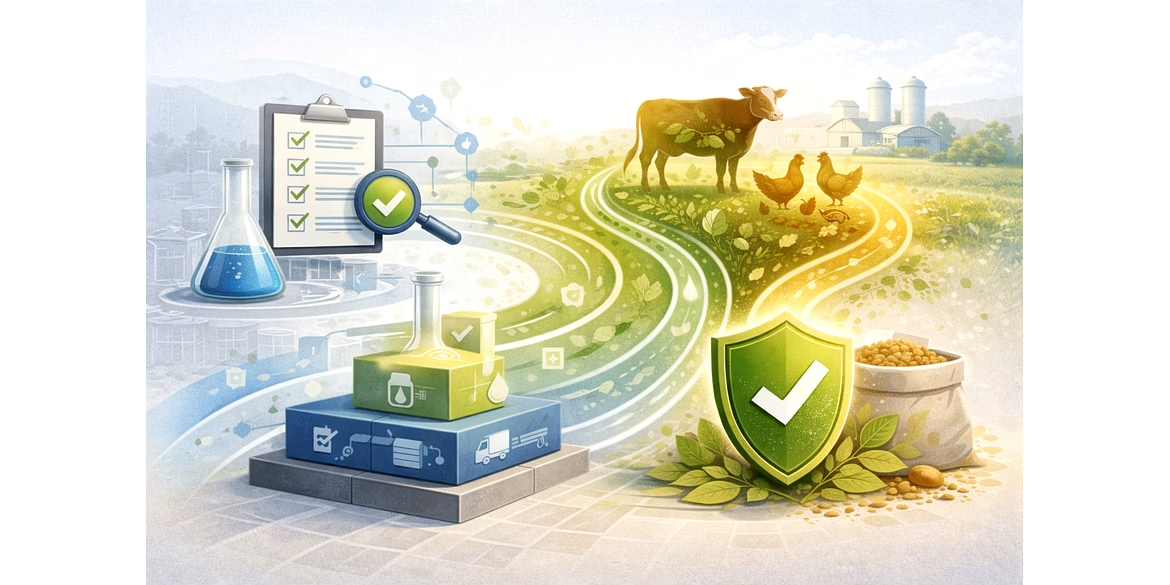

In the animal nutrition industry, product performance cannot be proven by laboratory formulation alone. For global buyers and corporate clients, one of the most important indicators of feed supplement reliability is on-farm validation under real-world conditions.
Field-tested feed supplements demonstrate consistent performance across diverse farming environments, helping buyers reduce risk, ensure quality, and build long-term trust with end users.
Field testing refers to the evaluation of feed supplements under actual farm conditions rather than controlled laboratory or trial environments alone. This process helps verify product performance in real-world scenarios involving variable feed quality, climate, management practices, and animal health challenges.
True field testing reflects everyday farming realities and provides practical insight beyond formulation accuracy.
Key elements of field testing include:• Use under commercial farm conditions
• Evaluation across different production systems
• Monitoring of performance, health, and consistency
• Feedback from farmers and technical professionals
Why Laboratory Testing Alone Is Not Enough
Laboratory testing is essential for formulation accuracy and safety, but it does not fully predict on-farm performance. Variables such as feed variability, environmental stress, and management differences can significantly influence results in poultry and livestock production.
Field testing bridges the gap between formulation and practical performance, offering insight into how products behave under real conditions.
Limitations of lab-only testing include:• Lack of environmental variability
• Controlled conditions that do not reflect real farms
• Limited insight into long-term performance
• Incomplete understanding of practical usability
On-farm validation allows manufacturers to refine feed supplement formulations using real performance data. Products that consistently perform well under field conditions are more reliable for large-scale and international use.
For buyers, this results in predictable outcomes and reduced operational risk across production cycles.
Reliability benefits of field validation include:• Consistent performance across batches
• Improved feed efficiency and productivity outcomes
• Reduced risk of performance variability
• Higher confidence in product claims
Field Testing and Global Buyer Confidence
Global buyers and corporate clients often operate across regions with varying farming conditions. Field-tested feed supplements are better suited for this diversity because they are proven to perform beyond ideal or controlled environments.
As a result, field validation has become a key due-diligence criterion in feed supplement sourcing decisions.
Why global buyers value field-tested products:• Reduced risk when entering new markets
• Greater consistency across different regions
• Improved acceptance by end users
• Stronger alignment with quality assurance standards
Manufacturers with strong field experience are better equipped to design effective feed supplements. Continuous interaction with farms provides insight into evolving challenges and performance gaps that may not appear in controlled testing.
This feedback-driven approach supports the development of practical, relevant, and resilient nutrition solutions.
Field experience contributes to:• Product refinement based on real outcomes
• Better understanding of farm-level challenges
• Improved application and usage guidelines
• Enhanced long-term product effectiveness
Field Validation and Quality Assurance Systems
On-farm validation complements manufacturing quality systems by confirming that feed supplements meet performance expectations beyond production. This strengthens overall quality assurance and reinforces product credibility.
For international buyers, field validation provides an added layer of assurance when sourcing for multiple markets.
Quality assurance benefits include:• Verification of performance claims
• Stronger documentation for buyers
• Improved traceability and accountability
• Greater trust in supplier capabilities
Buyers should actively evaluate whether field testing is meaningful and ongoing. Reliable manufacturers are transparent about validation processes and performance history, supporting informed sourcing decisions.
Key questions buyers should ask:• Has the product been tested under commercial farm conditions?
• Were trials conducted across different regions or systems?
• Is there documented performance feedback?
• Does the manufacturer use field data to improve products?